I still remember the frustration of my first high-tech 55-gallon tank in 2018. I had lush Amazon Swords and fast-growing Rotala, but every single week, the new leaves emerged looking like pale, sickly ghosts.
“It’s iron deficiency,” the forums said. So, I bought a bottle of iron fertilizer.
Nothing happened.
I doubled the dose.
Still yellow.
I tripled the dose.
Result: An explosion of hair algae so thick I had to throw away $200 worth of plants.
I didn’t understand then what I know now: Iron deficiency is rarely about a lack of iron in the water. It is almost always a bioavailability issue. Your plants are starving in a buffet because the chemistry of your water has “locked” the door.
If you are seeing yellowing on new growth (chlorosis), don’t just dump fertilizer in. We need to diagnose why the iron isn’t getting into the plant tissue.
What Is Iron Deficiency in Aquarium Plants?
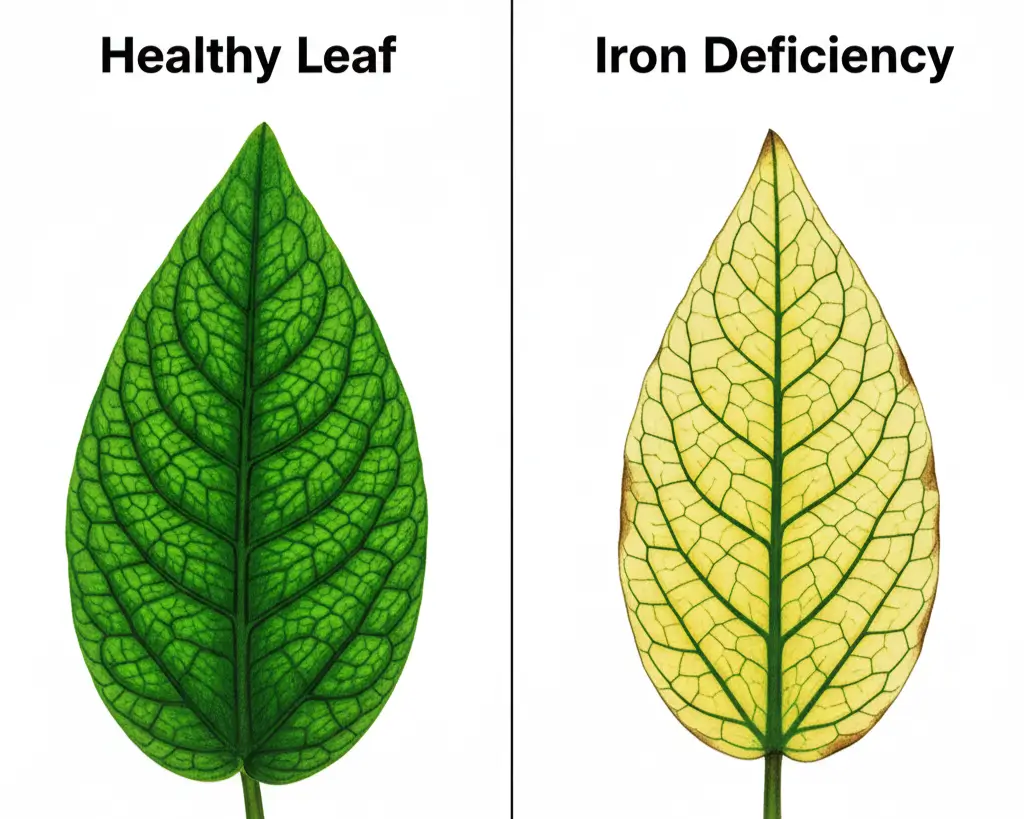
Iron deficiency in aquatic plants is characterized by interveinal chlorosis on new leaves. This means the new growth at the top of the stem or center of the rosette turns pale yellow or white, while the veins remain green.
Key Identifiers:
- Location: STRICTLY new growth (Iron is an immobile nutrient; the plant cannot move it from old leaves).
- Appearance: Yellowing tissue, green veins (in mild cases) to complete white bleaching (severe cases).
- Necrosis: In extreme cases, holes form and leaves die.
The “Immobile Nutrient” Rule (And Why It Matters)
Here is where most hobbyists get confused. You look at your tank, see yellow, and panic. But the location of the yellowing tells you the entire story.
Nutrients like Nitrogen, Phosphorus, and Potassium are mobile. If the plant runs out, it steals these nutrients from the old leaves to support the new ones. That’s why nitrogen deficiency shows up at the bottom of the plant.
Iron is immobile. Once the plant deposits iron in a leaf, it’s stuck there. It cannot move it. So, if the water column runs dry of iron for even 24 hours, the next leaf that opens will be yellow.
I learned this the hard way with my Ludwigia Repens Super Red Mini. I skipped dosing for a 4-day weekend trip, and when I came back, the tips were white. The old growth was deep red, the new growth was distinctively pale. It was a perfect timeline of my neglect.
The Real Culprit: Iron Lockout and pH
This is the part nobody talks about enough. You might have plenty of iron in your water, but your plants can’t touch it.
I spent months fighting this on a tank with Seiryu stone (which raises pH). My test kit said I had 0.5ppm of Iron (plenty!), but my plants were dying.
Why? Precipitation.
At a pH above 7.0, standard iron fertilizers interact with oxygen and hydroxyl ions to form insoluble hydroxides (iron rust, basically). The plant cannot absorb this. This is why understanding the difference between your GH and KH is critical, if your KH is driving your pH up, your iron dosing strategy must change.
The Chelation Solution: Matching Iron to Your Water
To stop iron from rusting instantly, manufacturers wrap the iron molecule in a chemical “claw” called a chelate. But not all claws are strong enough.
Iron Chelate Types
| Chelate Type | Effective pH Range | Stability | Best For |
| Fe-Gluconate | Very Short (< 1 hr) | Low | Daily dosing, rapid uptake |
| Fe-EDTA | pH < 6.5 | Moderate | Soft water, low pH tanks |
| Fe-DTPA | pH < 7.5 | High | Most community tanks |
| Fe-EDDHA | pH < 9.0 | Extreme | Hard water, Cichlid tanks |
“I switched from a generic EDTA fertilizer to a DTPA-based iron source in my 75-gallon hard water tank (pH 7.8). Within 10 days, the chlorosis vanished. I didn’t add more iron; I added usable iron.”
RECOMMENDATION:
- If pH is < 6.5: Use Fe-EDTA (Cheaper, totally effective).
- If pH is 7.0 – 7.5: Use Fe-DTPA (Standard for most planted tanks).
- If pH is > 7.5: Use Fe-EDDHA (Turns water slightly pink, but it works).
MYTH vs REALITY: The “Red Plant” Fallacy
One of the biggest arguments I see in Facebook groups involves red plants.
MYTH: “You need massive amounts of iron to make plants red.”
REALITY: High light and low nitrates are the primary drivers of red coloration (anthocyanin production). Iron helps, but it is not the trigger.
A 2008 discussion by Tom Barr (of the EI Dosing method) highlighted that while Iron is necessary for chlorophyll synthesis (making things green), the red comes from the plant protecting itself from intense light.
I ran a high-light tank with Rotala Rotundifolia Red.
- Test A: Low light, High Iron (0.5ppm). Result: Green plants.
- Test B: High light, Low Iron (0.1ppm). Result: Pink/Red tips.
Iron keeps the plant healthy enough to produce pigment, but light intensity drives the color. Don’t overdose iron trying to force redness, you’ll just feed Black Beard Algae.
Troubleshooting: Is It Actually Manganese?
Here is a curveball. Manganese deficiency looks almost identical to iron deficiency.
The Difference:
- Iron: Veins remain green, but fine veins may yellow in severe cases. Eventually, the whole leaf turns white/necrotic.
- Manganese: Veins stay VERY dark green, creating a checkerboard pattern.
The tricky part? Too much Iron causes Manganese deficiency.
If you are dosing iron like crazy (like I did in 2018) and the yellowing gets worse, you are likely blocking the uptake of Manganese. This is a classic example of “Mulder’s Chart” of nutrient antagonism. This is why I always recommend a balanced micro-mix like the Seachem Flourish line rather than isolating Iron unless you are 100% sure.
My 3-Step Protocol to Fix Yellow New Growth
If you wake up tomorrow and see pale tips on your Java Fern Windelov or stem plants, don’t panic. Follow this sequence.
1. Check Your Flow and CO2 First
Before you buy supplements, look at your filter. Is the flow reaching that specific plant?
In my 20-gallon long, I had a dead spot in the back corner. The Rotala there was yellow. The Rotala in the flow was green. Same water, same fertilizer. The nutrient wasn’t physically reaching the leaf boundary layer.
2. Verify Substrate Nutrition
If you are growing heavy root feeders like Sword plants or Cryptocoryne, liquid iron is almost useless. They feed from their feet.
I have revived a massive Amazon Sword that was practically translucent just by inserting root tabs (DIY or Osmocote) deep into the substrate. Within two weeks, the new leaves were emerald green.
3. The “Reset” Dosing
If flow is good and root tabs are present, then look at dosing.
- Step A: Do a 50% water change to reset any nutrient imbalances (excess iron blocking manganese).
- Step B: Switch to a DTPA-based iron if your pH is above 7.0.
- Step C: Dose lean for 2 weeks.
A Note on “Canary Plants”
Some plants show deficiency weeks before others. In my systems, I use fast growers as indicators.
Amazon Frogbit is my number one “canary in the coal mine.” Because it is a floater with access to unlimited CO2 (air), it grows fast and demands nutrients rapidly. If my Frogbit turns yellow, I know my water column is lean, usually 3-5 days before my submerged plants show signs.
The Systems Approach to Aquatic Health
We often try to treat aquariums like a car repair, swap out the broken part (add iron) and drive on. But nature is a web.
When I started Aquatics Pool Spa, I realized that the most successful hobbyists aren’t the ones with the most expensive fertilizers; they are the ones who understand balance. If you blast high light but don’t provide CO2, the plant can’t process the iron. If you overdose iron, you block manganese.
If you are struggling with this balance, look at your NPK ratio and EI dosing. Often, maximizing your macros (Nitrate, Phosphate, Potassium) kickstarts growth, and suddenly the “iron deficiency” resolves itself because the plant’s metabolism is finally working correctly.
Summary: What To Do Now
- Inspect: Is the yellowing on new leaves (Iron) or old leaves (Nitrogen)?
- Measure: Check your pH. If > 7.0, ensure your fertilizer uses DTPA or EDDHA chelation.
- Flow: Ensure water is moving around the affected plant.
- Root Feed: If it’s a rosette plant, use root tabs.
- Patience: Iron is immobile. The yellow leaves will not turn green again. You are looking for the next new leaf to be green. Trim the ugly ones once the plant recovers.
Don’t chase numbers. Chase healthy growth.